
Here's the thing about your body around your partner
Your nervous system doesn't care that your partner loves you. It doesn't care that you're in a committed relationship or that they've done everything right. When someone is watching, your body often goes into a slightly different mode. Arousal stalls. The pathway to orgasm gets quieter. You might feel sensation, even pleasure, but the final threshold stays locked.
This is so common that I'd call it the invisible third person in most partnerships. People describe it as pressure, self-consciousness, or just "my body won't cooperate." But it's actually a nervous system thing. Your brain is doing a tiny bit of monitoring, and that monitoring prevents the deep relaxation an orgasm needs.
A clitoral vibrator like the Lemon changes this dynamic in a specific way. It's not magic. But it does something that's often overlooked: it gives your body permission to focus on sensation rather than performance.
Why clitoral vibrators work when presence is the problem
When you use a vibrator with your partner nearby, three things shift:
First, the vibrator becomes the protagonist. Your attention goes to the stimulus itself, not to being watched receiving stimulus. This sounds small. It's not. Your brain needs something concrete to lock onto, and a vibration is precisely the right kind of concrete.
Second, a vibrator creates a physical boundary between your partner and your sensation. They're not creating the stimulation. They're present with you experiencing it. That distance is what allows some people to relax for the first time.
Third, using a device signals to your nervous system that this is different from partnered sex. You're not trying to come during penetration or manual stimulation. You're exploring pleasure on your terms, with them there. Your body recognizes the permission in that shift.
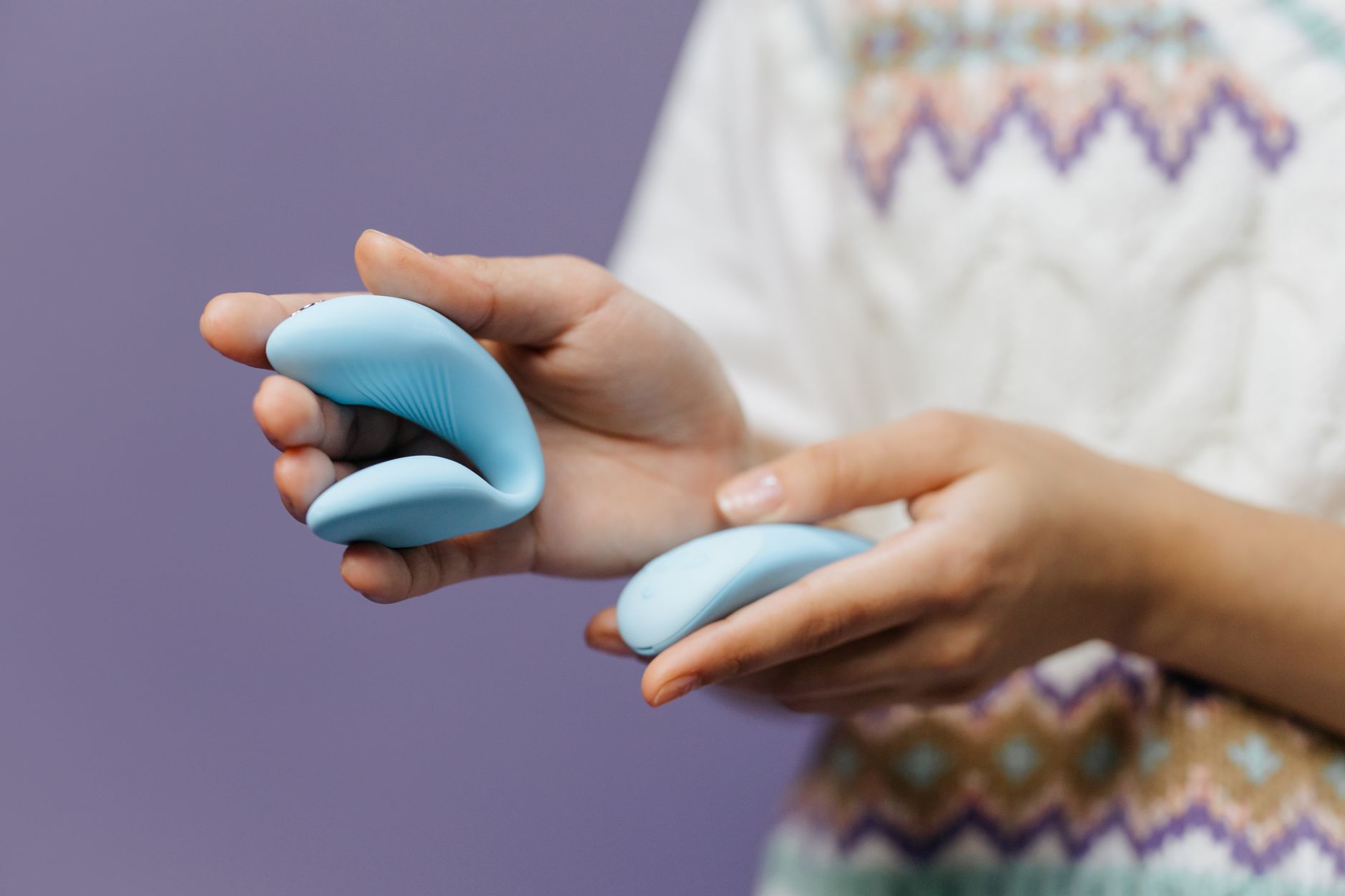
Photo by cottonbro studio on Pexels
The practical setup that actually works
Let's be concrete. Here's what I recommend to couples navigating this:
Start with a conversation before you try anything. Not "we're going to fix your orgasm." Instead, "I notice you relax more when you're solo, and I want to create space for that. What would feel good?" This takes the pressure completely off and frames it as something you're doing together.
When you're ready, have your partner stay in the room but give you physical space. Not in a corner. Just not directly between your legs. They can be reading, or beside you, or even touching you elsewhere on your body while you use the vibrator. The key is that the clitoral stimulation is yours alone.
Start with lower intensity settings on your lemon vibrator. Patterns 1 or 2. Many people who struggle with orgasm around a partner also have an easier time with gentler stimulation, since intense vibration can sometimes increase performance pressure. Let arousal build for 10-15 minutes minimum. Rushing this defeats the point.
Your partner can touch your body in non-genital ways. Hair, chest, shoulders, inner thighs. This keeps intimacy present while you focus on clitoral sensation. If you want them to be completely hands-off, that's fine too.
What actually happens in your nervous system
When you come with a vibrator while your partner is present, something changes in your brain. You've now proven to yourself that orgasm is possible with them nearby. That's neurologically different from believing it's impossible.
The next time, the barrier is smaller. Eventually, many people find they can orgasm during partnered sex too, because the nervous system has been recalibrated. Orgasm becomes possible in their presence, period.
But here's what matters more than that: you get to experience your own pleasure as a normal part of your intimate life. Not performance. Not something you have to hide or apologize for. Just sensation, your body, theirs, and a tool that helps you access what's yours.
The emotional part (this is the big part)
Many people who can't orgasm with a partner carry some shame about it. They feel broken, or like they're letting their partner down. Using a clitoral vibrator together can flip that narrative entirely.
When your partner sees that you need vibration, that you relax more with it, that your pleasure looks different than they maybe imagined, most good partners recognize it for what it is: data. Not rejection. Just information about your body.
If your partner responds with resentment or pressure, that's a separate problem worth addressing, ideally with a couples therapist. A partner who loves you wants you to come. If they'd rather you fake it than use a tool that works, that's worth examining.
For most people though, there's relief in the honesty. You're not pretending. You're not forcing. You're showing up as you actually are.
How this changes partnered sex itself
Once you've had an orgasm with your partner present, via vibrator, a few interesting things happen.
You might find that partnered sex without the vibrator feels more relaxed anyway, because the impossible pressure has lifted. You've already come with them there. The stakes are different now.
You might discover that you like the vibrator during penetration, and your partner likes that too. This is common and worth exploring without judgment.
You might find that you need the vibrator sometimes and not other times. Pleasure isn't static. Some days your body is ready for one kind of stimulation, other days it needs something else. A good intimate partnership makes room for that.
Some couples find that using a Lemon vibrator together becomes part of their sexual rhythm. Not a problem-solving tool, but just part of what intimacy looks like for them. That's honestly where a lot of people end up, and it's great.
When to go deeper (literally)
If you've tried this and nothing shifts, a few other things are worth considering.
Some people benefit from talking to a sex therapist or pelvic floor physical therapist. Sometimes the block is muscular tension, not mental. Sometimes there's past trauma or medical stuff at play. None of that is shameful, and all of it is addressable.
You might also explore whether the block is specifically about penetration, or about orgasm in general with your partner. These are different problems with different solutions.
And if your partner is unwilling to try this, or dismissive about it, that's worth a couples conversation. How to Use a Lemon Vibrator When Your Partner Wants More Stimulation Than You Do covers some of those dynamics if mismatched desire is part of the picture.
The bigger truth
Your body isn't broken because it responds differently when someone's watching. That's human. Most nervous systems do this. The fact that you're aware of it and willing to work with it, rather than against it, already puts you ahead.
A lemon vibrator isn't a cheat. It's not a sign that something's wrong with your relationship. It's a tool that acknowledges how your body actually works, and it creates space for you to come exactly the way you need to.
That's how you build real intimacy, by the way. Not by performing the version of sexuality you think you should want. But by showing your partner who you actually are, and letting them love that.
People also ask
Why can't I orgasm with a partner but I can alone?
Performance pressure and being watched activate your sympathetic nervous system (fight-or-flight), which literally inhibits orgasm. Solo, there's no one observing, so your parasympathetic nervous system (rest-and-digest) dominates. This is why you can relax. It's biology, not a reflection on your relationship or your partner's skill.
Does using a vibrator with my partner present make them feel bad?
Some people feel inadequate at first, especially if they've internalized the idea that they should be able to bring you to orgasm alone. A good conversation helps: frame it as "I need this to relax," not "you're not enough." Once they see you come, most partners feel relief and closeness, not rejection. If they don't, that's worth exploring together.
Will I always need the vibrator to orgasm with them?
Not necessarily. Many people use a clitoral vibrator initially to build confidence and recalibrate their nervous system, then find they can come without it as that confidence grows. Others find they like the vibrator as part of their regular intimate life, and that's fine too. Your body will tell you what it needs over time.
What if my partner wants to use the vibrator on me instead?
That can work beautifully, but the key is control. You holding the vibrator gives you agency over pressure, speed, and position. If your partner holds it, ask them to follow your cues closely. Some people like handing it over once they're close to orgasm. Others prefer to keep control the whole time. Both are valid, and either can work. Test what your body prefers.
Can I orgasm during penetration if I use a vibrator on my clitoris at the same time?
Yes. Many people find that adding clitoral vibration during penetration is the key to orgasm during partnered sex. This is so common that I'd call it standard, not a workaround. If it works for your body, it works. How to Use a Lemon Vibrator When Switching From Penetration-Focused Sex digs into this more.
Is there something wrong with me if I need a vibrator to come?
No. Clitoral vibrators are legitimately more effective for most people than other forms of stimulation. The intensity, consistency, and specific pattern of vibration matches how many nervous systems are wired for orgasm. Needing one doesn't mean you're broken. It means you know what works for your body, and you're using the right tool. That's sexual maturity, not failure.
Sources
Gottman, J. M., & Silver, N. (2015). The Seven Principles for Making Marriage Work. Harmony.
Esposito, G., & Cuzzocrea, F. (2011). Affiliative and non-affiliative touch as a sensitive period marker for developmental processes. Neuroscience and Biobehavioral Reviews, 35(9), 1984-1989.
Ivanova, A. E., et al. (2020). The role of clitoral stimulation in female orgasm during partnered sexual activity. Journal of Sex & Marital Therapy, 46(4), 362-375.